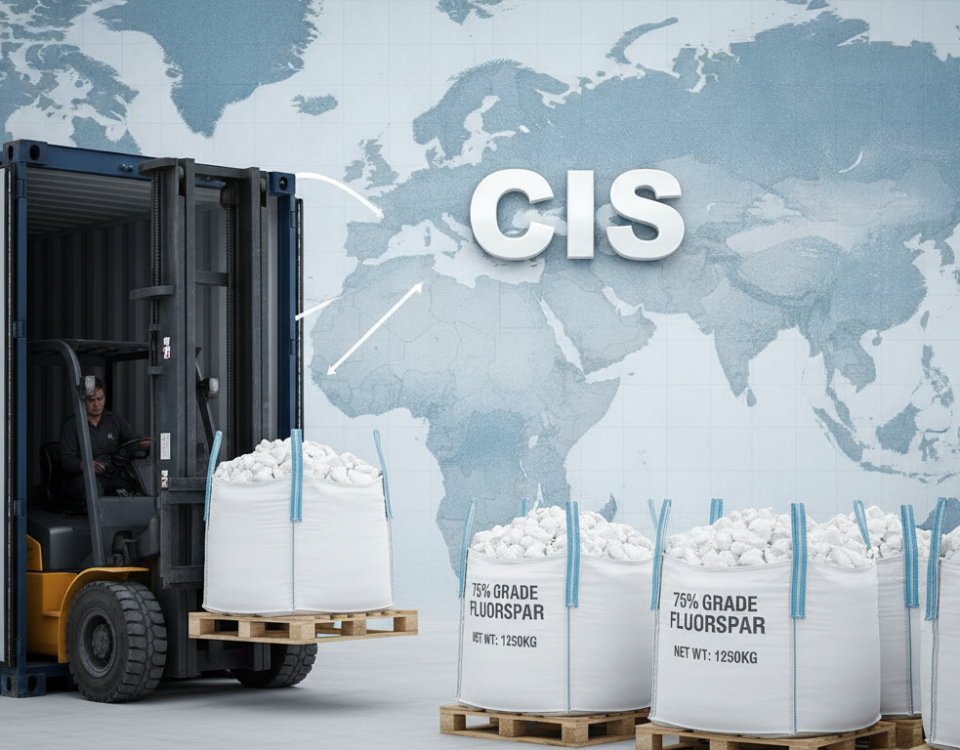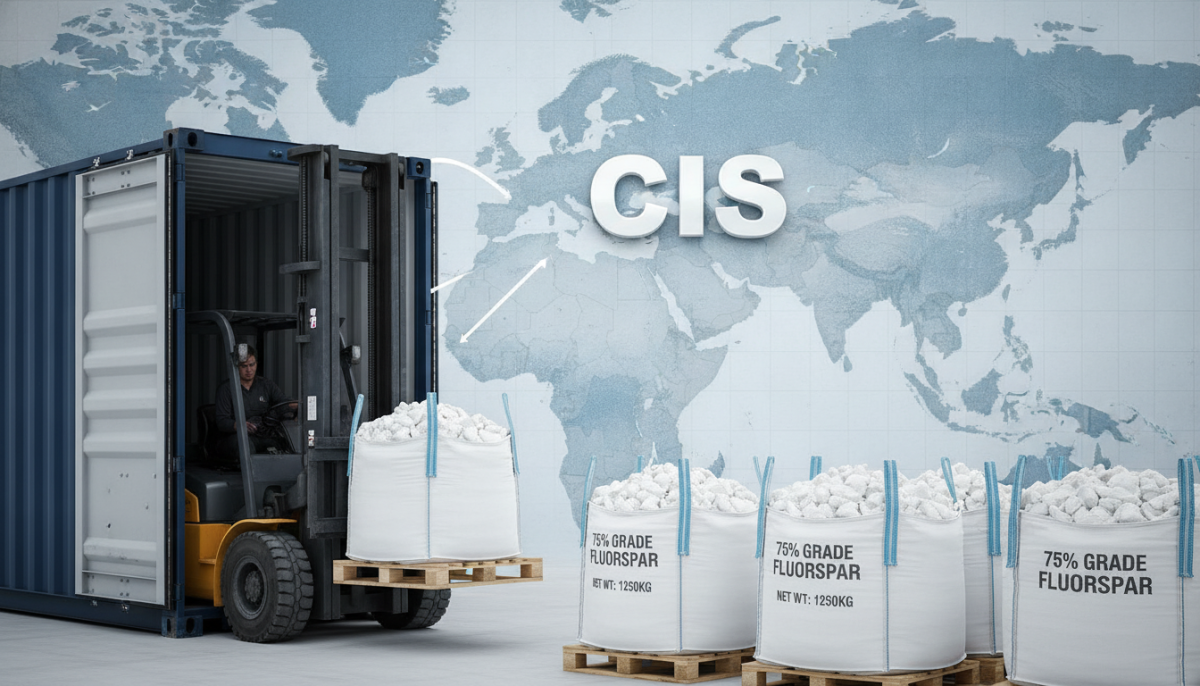

Fluorspar for Russia & CIS: GOST & Supply
2026-09-12
In modern steelmaking, the Ladle Furnace (LF) and Electric Arc Furnace (EAF) are tasked with a critical objective: achieving “Clean Steel,” precise melt chemistry, and the removal of deleterious elements in the shortest cycle time possible. The heart of this process lies in Slag Engineering.
A long-standing debate persists among metallurgists and procurement units regarding the choice between pre-melted/sintered calcium aluminate synthetic slags and natural metallurgical fluorspar (Metspar with 70–85% CaF₂). This comprehensive analysis dissects the process through the lenses of phase thermodynamics, surface reaction kinetics, refractory integrity, and Operational Expenditure (OPEX).
1. Thermodynamic Principles: Fluxing and Silicate Network Modification
Secondary metallurgy slags primarily reside in the multi-component system. Calcined lime, the primary agent for basicity and sulfur absorption, has a high melting point (). At steel melt temperatures (), lime dissolution into the slag phase is kinetically hindered by a dense layer of dicalcium silicate ( or ), which has a melting point of approximately .
The Fluorspar (, 70–85%) Ionic Mechanism
Fluoride ions (F−) act as “Network Breakers.” In the silicate liquid phase, bridging oxygen bonds (Si−O−Si) are ruptured, and complex silicate polymeric structures are decomposed into smaller units:
This ionization creates two critical thermodynamic and physical effects:
- Liquidus Temperature Reduction: Based on the ternary equilibrium diagram, an addition of just 3–8% lowers the slag solidification temperature to below , rapidly dissolving the resistant layer surrounding lime particles.
- Dynamic Viscosity Reduction (η): Slag viscosity drops from suboptimal levels () to the optimal range of , facilitating rapid species transport.
2. Desulfurization Kinetics and Sulfide Capacity
Desulfurization at the slag-metal interface is an electrochemical mass-transfer reaction:
Sulfur removal rate () is a direct function of the sulfur mass-transfer coefficient () and the effective slag-metal contact area ():
According to the Ritz-Seki relationship () and the Stokes-Einstein equation (), lowering viscosity () exponentially boosts sulfur diffusivity and narrows the static boundary layer ().
- Synthetic Slag: Requires 50–55% and 40–45% for sulfide capacity. While phases assist rapid melting, dissolution and fluidity improvements are significantly slower than the dynamics of fluoride ions.
- Natural Fluorspar: By drastically reducing boundary layer resistance, it shortens the time required to reach desulfurization equilibrium by 3 to 6 minutes. This time reduction directly correlates to lower LF active power consumption (kWh/ton) and reduced thermal loss.
3. Inclusion Control: Clean Steel and Alumina Modification
While proponents of synthetic slag highlight the ability of calcium aluminates to absorb corundum () inclusions in Al-killed steels, natural fluorspar-conditioned slag offers a superior metallurgical reality.
Due to high surface activity (), slag conditioned with lime and high-grade natural fluorspar exhibits exceptional capillary force. This force effectively “wets” and absorbs alumina clusters () and spinel precipitates (). Fluorspar-activated slag covers the inclusion absorption window without the exorbitant cost of pre-synthesized aluminate compounds.
4. Managing Slag Chemistry and Silicate Phases ()
When selecting fluorspar lumps, the gangue composition is as critical as the content.
Purity (Trace Elements): For high-end “Clean Steel,” the primary risk is the re-introduction of Phosphorus and Sulfur via slag additives. Elite Fluor’s mineral-grade fluorspar ensures near-zero P and S content, ensuring the slag’s capacity is utilized solely for removing impurities from the metal rather than balancing additive impurities.
Basicity Balance: In loads with siliceous gangue, silicates enter the slag alongside fluoride. Since silica is an acidic oxide, lime additions must be adjusted to maintain secondary metallurgy basicity ().
Advantages over Carbonate-based Fluxes: Unlike calcium carbonate () based additives, high-grade fluorspar involves no endothermic decomposition reactions (), preventing melt temperature drops and unwanted “foaming” caused by gas evolution.
5. Comprehensive Technical and Operational Comparison
| Technical Parameter | Synthetic Slag (Pre-melted) | Natural Metallurgical Fluorspar (70-85%) |
|---|---|---|
| Main Phase Composition | ||
| Consumption (kg/ton steel) | 6 – 10 kg | 1.5 – 3.5 kg |
| Viscosity Reduction Mechanism | Eutectic formation () | ion polymer chain rupture (Immediate) |
| Homogenization Time | 6 – 10 minutes | 2 – 4 minutes |
| LF Energy Impact | Moderate | Highly favorable (-4 to -7 kWh/t) |
| H2 Pick-up Risk | High (hygroscopic) | Negligible (non-hygroscopic) |
| Dedusting / Fines | High loss (powdery) | Minimal loss (lump sizing 10-50mm) |
| Cost Index | 100 (Baseline) | 25 – 35 (65-75% Cost Reduction) |
6. Economic Analysis: OPEX Optimization
Consider a steel plant producing 500,000 tons annually. The primary difference lies in “Consumption Intensity.”
- Logistics Efficiency: To achieve identical slag quality, you must handle 3x the volume of synthetic slag compared to natural fluorspar. This translates to 3x the transportation costs, 3x warehouse space, and 3x material handling operations.
- Energy-Per-Ton: Reducing LF power-on time by 5 minutes per heat saves massive electricity and reduces graphite electrode consumption. This energy saving often exceeds the entire purchase cost of the fluorspar itself.
- Inventory Stability: Natural mineral fluorspar is shelf-stable and non-perishable, unlike moisture-absorbing synthetic powders that pose risks of hydration or clumping.
7. The Optimal Choice
While synthetic calcium aluminate maintains a niche in specific automotive/aerospace steel grades where fluorine presence is restricted, Natural Metallurgical Fluorspar (Metspar 70-85%) remains the standard for commercial, structural, alloy, and ductile iron production. It guarantees the ideal balance between reaction speed, desulfurization capacity, and cost control.
Elite Fluor ensures reliable, long-term supplies of high-grade fluorspar, directly from our own mines with strictly engineered quality control.
Contact Elite Fluor for XRF analysis reports, pilot testing, or daily pricing:
- Sales & Procurement: sales@elitefluor.com
- Technical Support & Phone: +98 51 318 20 222 | +98 912 272 0913