
Technical Application of Fluorspar in the Glass Industry: From Melting Point Reduction to Improved Transparency
2025-10-30
The Future of Fluorochemistry Worldwide and the Strategic Role of Fluorspar
2025-12-12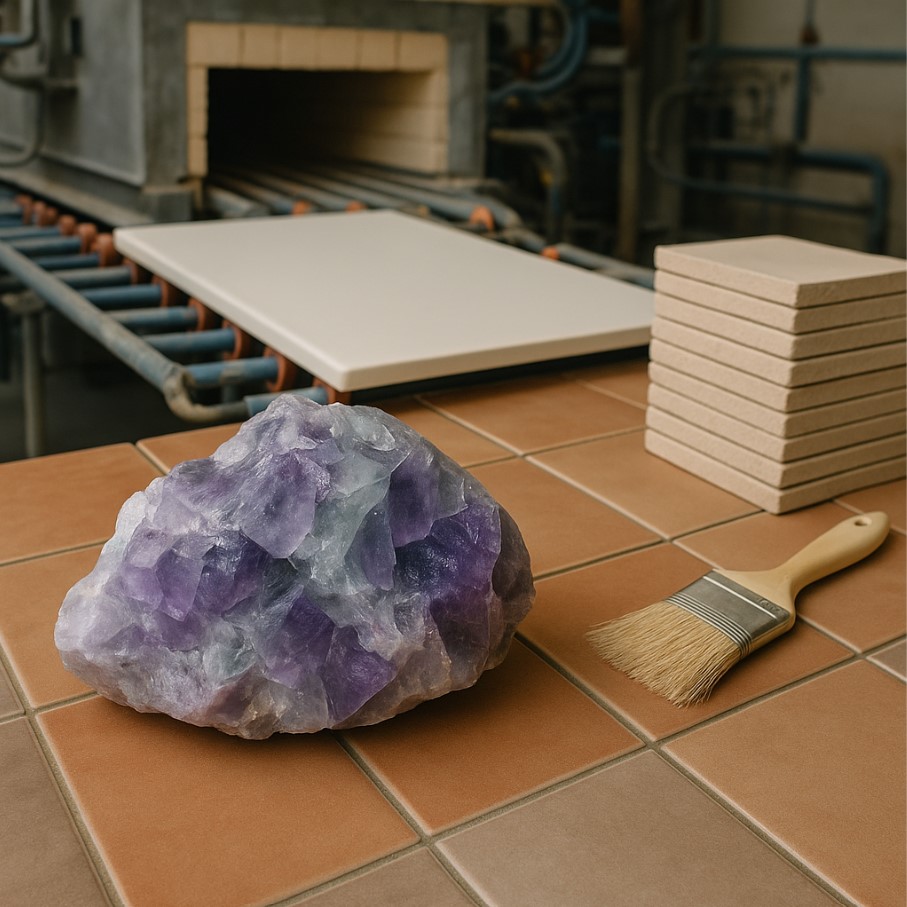
Introduction
The ceramic and tile industry is one of the most influential sectors in the field of construction materials, relying on advanced thermal and chemical processes to achieve high-quality products such as porcelain tiles, engineered bodies, and technical glazes. Among the mineral additives used in this industry, fluorspar (CaF₂) occupies a particularly important position. Beyond serving as a flux in high-temperature reactions, fluorspar significantly influences product quality, melt behavior, body density, and the surface properties of glazes. With the global shift toward energy optimization and the expansion of porcelain tile production, the use of fluorspar has gained increasing attention.
This article provides a comprehensive and scientific review of the role of fluorspar in the ceramic and tile industry. It examines how fluorspar influences body preparation, firing behavior, frit production, glaze formulation, and the microstructure of the final product. Additionally, it evaluates global consumption patterns and the specific grades of fluorspar required in this sector. The goal is to deliver a complete reference for technical experts, manufacturers, and researchers within the ceramic industry.
The Role of Fluorspar in Ceramic and Tile Manufacturing
The influence of fluorspar extends across several stages of the production process. Its effects can be categorized into thermal behavior, melt formation, microstructural development, and enhancement of both body and glaze quality. Unlike many additives, fluorspar impacts the process from the preparation of raw materials to the final firing stage.
1. Influence on Firing Temperature and Thermal Behavior
Firing is an energy-intensive step in ceramic production, where raw materials undergo sintering. Fluorspar promotes the early formation of liquid phases, thereby reducing the sintering temperature. This accelerates the bonding between silica, feldspar, dolomite, and clay particles, allowing the body to reach the required density at a lower temperature.
This temperature reduction yields several industrial benefits:
- Lower fuel consumption
- Reduced production costs
- Shorter kiln residence time
- Decreased thermal stresses that could otherwise cause cracks
2. Role in Increasing Body Density and Final Strength
The goal of body preparation is to achieve a dense structure with minimal porosity. Fluorspar enhances the formation of glassy phases at lower temperatures, enabling these molten phases to fill voids more efficiently. As a result:
- Body density increases
- Mechanical and flexural strength improves
- Porosity and water absorption decrease
This is especially valuable for porcelain tiles, where extremely low water absorption levels are required.
3. Chemical Stability and Color Uniformity
Fluorspar also influences the chemical reactions within the body. It can moderate unwanted interactions between oxides and helps stabilize color in fired bodies. Furthermore, its tendency to react with trace iron impurities can enhance the brightness and uniformity of light-colored tiles.
Fluorspar in Glaze and Frit Production
Although fluorspar benefits the tile body, its most critical and advanced application lies in frit and glaze production. In this stage, fluorspar directly affects melt chemistry and optical behavior.
1. Reducing Melt Viscosity and Improving Fusion
One of the major challenges in frit production is achieving a homogeneous melt. Fluorspar interacts with the silicate network at high temperatures, partially breaking Si–O bonds and smoothing the flow of the molten mass. This results in:
- Lower melt viscosity
- More uniform fusion
- Reduced defects such as undissolved particles or incomplete melting
2. Increasing Transparency and Gloss of the Glaze
By altering the refractive properties of the glass network, fluorspar contributes to higher transparency and improved surface gloss. This makes it essential in:
- Glossy glazes
- Transparent glazes
- High-whiteness coatings
- Artistic and decorative frits
3. Controlling Thermal Expansion (CTE)
Matching the thermal expansion of glaze and body is crucial to prevent crazing or peeling. Fluorspar helps adjust the glaze’s thermal expansion coefficient, enabling smoother compatibility between glaze and ceramic body.
Stages of the Process Where Fluorspar Is Used
Fluorspar is used at multiple points in the ceramic manufacturing workflow:
1. Body Preparation
Fluorspar is added during milling or blending of the raw materials. Typical dosage ranges from 0.5% to 1%, aimed at reducing firing temperature and improving densification.
2. Frit Production
The frit-making stage is one of the most significant points of fluorspar consumption. Here, finely ground fluorspar enters the melting furnace and participates directly in glass formation.
3. Glaze Formulation
Depending on the formulation, fluorspar may also be added directly during glaze milling, especially in specific transparent or glossy glaze systems.
Global Consumption of Fluorspar in the Ceramic Industry
Fluorspar consumption varies widely among countries, depending on their ceramic production capacity, export activity, and local frit technology. The leading consumers of fluorspar for ceramic applications include:
- China – the world’s largest tile producer and a major consumer of fluorspar for both body and frit production.
- India – strong growth in porcelain tiles and frit production.
- Spain and Italy – global leaders in advanced frit and glaze technologies.
- Turkey – one of the largest regional manufacturers with significant frit usage.
- Iran – a major regional producer of tiles and frits with expanding fluorspar usage.
While countries like Oman and UAE have active ceramic industries, their total consumption of fluorspar is moderate to low compared to the regions above, as much of their frit and glaze is imported.
Types of Fluorspar Used in the Ceramic Industry
Different grades of fluorspar are used depending on the stage of production and the required purity level:
Ceramic Grade Fluorspar
- Purity: 85–93% CaF₂
- Fine particle size (150–200 mesh)
- Mainly for body preparation and general frit applications
Acid Grade Fluorspar (97% CaF₂)
- Purity: 95–97% CaF₂
- Low impurity levels
- Essential for high-transparency frits, glossy glazes, and premium porcelain finishes
Ultra-Fine Fluorspar (200–325 mesh)
- Used in highly reactive frits and specialized glaze formulations
Additional Technical Notes on Fluorspar Use in Ceramics
Several important points—often overlooked—are also relevant:
1. Influence on Glaze Drying Behavior
Fluorspar can reduce surface tension, leading to smoother glaze application and more uniform drying.
2. Reduction of Bubble Formation in Glazes
By helping release trapped gases during melting, fluorspar minimizes bubble retention and increases clarity.
3. Impact on Glaze Rheology
Fluorspar-containing glazes often display improved flow behavior during application.
4. Enhanced Thermal Stability in Porcelain Bodies
Fluorspar reduces thermal strain during firing, decreasing the likelihood of warping.
Conclusion
Fluorspar is one of the most important mineral additives in ceramic manufacturing, influencing multiple aspects of both body and glaze production. Through lowering firing temperatures, modifying melt behavior, improving transparency, controlling thermal expansion, and enhancing mechanical strength, fluorspar enables higher-quality and more energy-efficient ceramic production. Countries such as China, Spain, Italy, India, Turkey, and Iran are among the major consumers of fluorspar in ceramic applications, while regional producers like Oman and the UAE contribute to growing—but comparatively smaller—demand.
Elite Fluor supplies high-quality ceramic-grade and acid-grade fluorspar specifically tailored for tile manufacturers, porcelain producers, and frit/glaze manufacturers, ensuring consistent performance and formulation stability.