Differences Between Fluorspar Grades: Metallurgical, Acid, and Ceramic
2025-07-07
Advanced Fluorspar Analysis Methods: Ensuring Quality through Specialized Testing
2025-07-09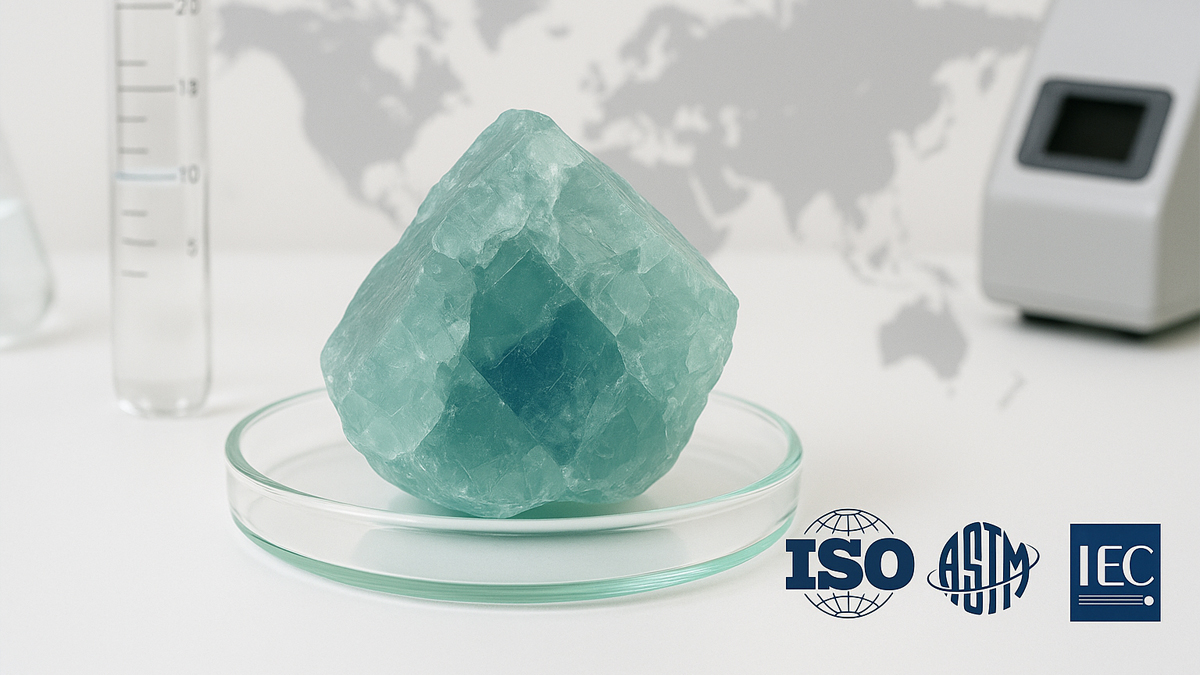
Introduction
In the global mineral market, quality is the key factor distinguishing a product sold at a premium from one sold merely for volume. This is especially true for fluorspar (CaF₂), which finds critical applications across metallurgy, chemical, glass, ceramics, and advanced technologies—each demanding different purity levels and strict quality control.
Industrial buyers worldwide consider not only the CaF₂ purity but also compliance with recognized international standards as prerequisites for trade. Without standardization, even high-quality fluorspar risks losing access to lucrative export markets.
This article reviews how global fluorspar purity standards are defined, their differences, and the technical and quality requirements Iranian producers must meet to compete internationally.
Fluorspar Grade Classification in Global Standards
Fluorspar is commonly classified by CaF₂ content into three main grades, with additional criteria such as particle size, impurity levels, color, and moisture influencing categorization. Understanding these grades and associated standards is essential for producers, exporters, and industrial buyers.
Metallurgical Grade
- CaF₂ Purity: Typically 60% to 85%
- Use: Flux in steel, foundry, and cast iron industries
- Features: Darker color, coarse or broken particles, relatively low cost, tolerates higher impurities (e.g., SiO₂, Fe)
- Mainly consumed domestically or in non-critical industrial applications.
Ceramic Grade
- CaF₂ Purity: Approximately 85% to 95%
- Use: Tiles, porcelain, glass, glaze, industrial ceramics
- Features: Lighter color (white to light gray), controlled particle size, stricter limits on optical and metallic impurities
- Competitively exported with tight impurity control and uniform appearance.
Acid Grade
- CaF₂ Purity: Above 97%
- Use: Hydrofluoric acid (HF) production, chemical, petrochemical, optical, energy sectors
- Features: Very high purity, minimal impurities (<1%), fine uniform particles, slightly bluish-white color, strict analysis and documentation
- Highest value, most sensitive, and most demanded grade globally.
Complementary Criteria in Global Standards
Beyond CaF₂ purity, international standards commonly regulate:
| Parameter | Importance |
| SiO₂ (Silica) | Lower is better, critical in acid grade |
| Fe₂O₃ (Iron oxide) | Negatively affects color and optical properties |
| Pb, As, S (Heavy metals) | Restricted or banned in sensitive industries |
| Moisture | Usually must not exceed ~0.5% |
| Particle Size | Must meet industry-specific ranges |
| Color and Visual Uniformity | Crucial for export markets |
The classification of fluorspar grades according to global standards is not limited to purity percentage alone; it also includes a combination of technical and visual parameters that directly affect the price, application, and market demand. A precise understanding of these grades is the first essential step for professional entry into the global fluorspar market.
Major International Standards for Fluorspar Purity
In the fluorspar industry, product compliance with global standards is essential for accessing international markets. These standards specify the required purity levels, types of impurities, particle size, and physical conditions that a product must meet to be accepted for specific industrial uses.
In this section, we review the most important international and technical standards commonly applied in the buying and selling of fluorspar.
ASTM International (USA)
- Relevant Code: ASTM D1179 (CaF₂ determination)
- Test Methods: Wet chemistry or spectrophotometry
- Application: Chemical, pharmaceutical industries, North American importers
- Emphasizes analytical precision, QC methods, and impurity limits.
ISO (International Organization for Standardization)
- No specific fluorspar standard, but many countries apply ISO standards for chemical analysis, purity testing, particle size, and packaging.
- Relevant: ISO 3262 (powder minerals), ISO 9001 (quality management).
DIN (Germany)
- Used mainly in European ceramic, glass, and metallurgy industries
- Focuses on chemical composition, particle size, and optical properties
- Especially relevant for ceramic and metallurgical fluorspar.
GB/T (China National Standard)
- Reference: GB/T 5195.1 – 2006
- Very detailed and stringent, governing grades from 60% to 98% purity, impurity limits, packaging, moisture, particle size, and lab analysis
- Compliance required for fluorspar exports to China.
Appropriate Fluorspar Purity by Industry Application
| CaF₂ Purity Range | Typical Grade | Industry |
| 60% to 90% | Metallurgical Grade | Steel and Metallurgy |
| 90% to 97% | Ceramic Grade | Ceramics and Glass |
| Above 97% | Acid Grade | Chemical and HF Production |
For a detailed review of the technical, economic, and practical differences between these grades, read the following article:
Differences Between Fluorspar Grades: Metallurgical, Acid, and Ceramic
Iran’s Position Regarding Global Standards
Iran holds significant fluorspar reserves but faces challenges:
- Predominantly traditional, non-standard processing in many mines
- Inadequate impurity control (especially Fe, SiO₂, Pb)
- Lack of official analyses and certified purity documentation
- Weak packaging, particle uniformity, and export documentation
- Gap relative to standards like GB/T (China) and ASTM (USA)
Growth Opportunities:
- Suitable reserves with quality improvement potential
- Rising global demand for high-grade fluorspar
- Entry of private sector into advanced processing
- Adoption of technologies like UV sorting, modern flotation, and optical quality control
🔗 If you want to see how Iran can move closer to global standards, we recommend the following article:
Fluorite Processing with UV Sorter: Cutting-Edge Technology for High Purity
Summary: Standardization—A Prerequisite for Global Fluorspar Market Competition
Fluorspar is more than a raw mineral; it is a high-value industrial commodity whose price, application, and market are directly tied to purity and compliance with international standards.
Key takeaways:
- Fluorspar is classified into metallurgical, ceramic, and acid grades.
- Each grade has specific purity and technical criteria.
- Stringent export standards such as ASTM, GB/T, and DIN define acceptance requirements.
- Compliance is critical for successful global competition.
For Iran to move beyond raw export and capture larger global market shares, the path is clear: precision processing, continuous quality control, global standard adherence, and establishing a reliable mineral brand.